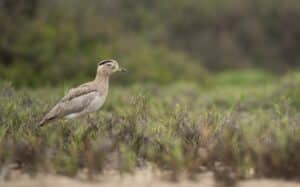
The Peruvian Thick-knee: Lima's Ghostly Voice of the Desert Night
Walk past a vacant lot, a golf course fairway, or the edge of an irrigated field almost anywhere around Lima after sunset, and you may hear the Peruvian Thick-knee before you ever lay eyes on it: a burst of loud, urgent yelps carrying across the dark. By day this odd, long-legged bird is nearly invisible, standing motionless on bare ground with plumage that mimics dirt and stone. By night it becomes one of the most vocal birds of the coastal desert. Learning to find and appreciate this strange nocturnal shorebird is one of the small pleasures built into our Birding in Lima and Photography Tours, and it rarely fails to become a favorite among visiting birders once they understand its habits.
A Bird You Hear Long Before You See It
The Peruvian Thick-knee spends daylight hours sitting quietly in pairs or small groups, often so still that walkers pass within a few meters without noticing. Once the sun goes down, everything changes. The bird becomes active and vocal, patrolling open ground on its long legs and giving far-carrying, yapping calls that are often the first and only clue to its presence. Local guides around Lima learn to identify likely daytime roosting spots—a bare corner of a field, a patch of gravel, the rough of a golf course—long before they ever expect to hear the bird after dark.
Built for Life on the Desert Edge
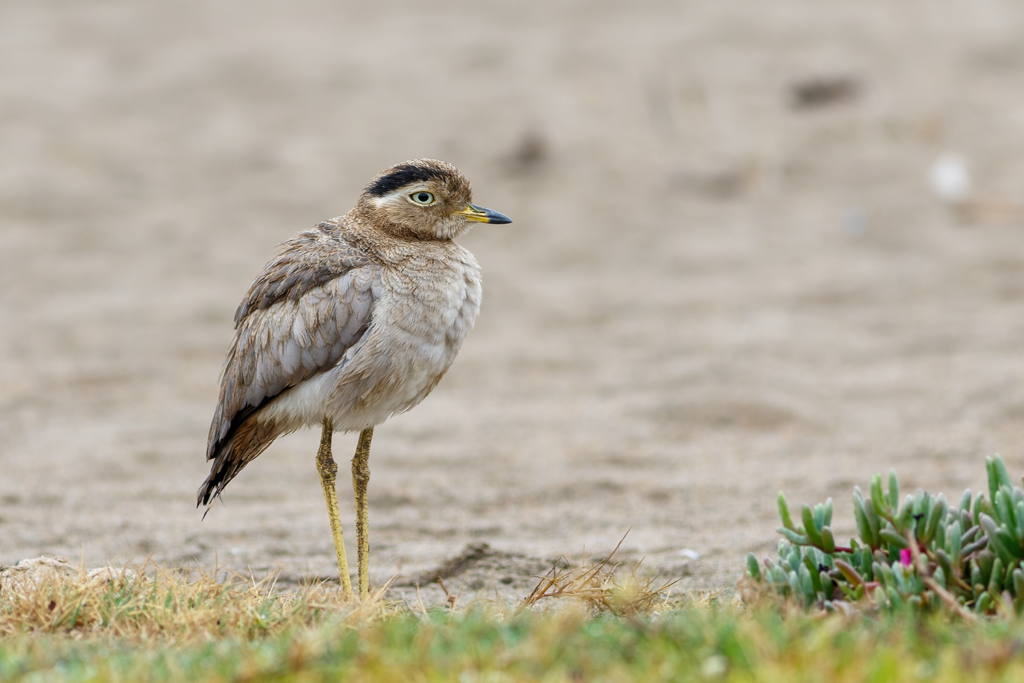
At 40 to 45 centimeters long, the Peruvian Thick-knee is a substantial bird with an unmistakable silhouette: a large, square-looking head, oversized pale eyes built for night vision, and long, greenish legs that end in a swollen joint—the “thick knee” that gives the family its name. Its brownish-gray plumage, streaked and spotted with pale markings, blends seamlessly into the sandy, stony ground it favors, making the bird disappear the moment it stops moving.
Where to Find the Peruvian Thick-knee Around Lima
Unlike many of the region’s endemic specialties, the Peruvian Thick-knee does not require a long drive into the Andes. It favors agricultural land and vegetated river valleys carved into the coastal desert, doing particularly well in fields of corn, alfalfa, and other crops that keep the ground open and unobstructed. It also turns up in vacant lots, dirt margins, and even small dirt plots inside towns and villages, where it seems remarkably tolerant of people. The fog-fed hills and adjoining farmland around Lomas de Lachay and the wetland-edge fields near Ventanilla Marshes are both reliable places to look for it on a day out from Lima.
Frozen in Plain Sight: A Master of Camouflage
By day, the Peruvian Thick-knee’s main defense is stillness. Rather than flee an approaching observer, it typically freezes low to the ground, trusting its cryptic plumage to do the work of hiding it. Pairs and small groups will often stay motionless for long stretches on sandy or stony soil with scattered vegetation, and it takes a practiced eye—or a lucky glance at the right silhouette—to pick one out before it moves.
The Night Shift
As dusk falls, the Peruvian Thick-knee comes into its own. It feeds mainly on insects and other small invertebrates, along with some grains, actively foraging across open ground once the heat of the day has passed. Its presence after dark is usually announced long before it is seen, as far-carrying yaps ring out across fields and empty lots—an eerie, distinctive soundtrack of the Lima night for anyone staying near its favored habitat.
An Odd Anatomy With a Purpose
Every part of the Peruvian Thick-knee’s unusual build serves its nocturnal, ground-dwelling lifestyle. The oversized eyes gather what little light is available after sunset. The long legs and the enlarged tibiotarsal joint that gives the thick-knee family its name allow for a fast, low walk across open terrain. And the streaky, earth-toned plumage that looks plain in a field guide becomes remarkably effective camouflage the moment the bird settles onto bare ground.
A Familiar Face Across the Region
The Peruvian Thick-knee is not a narrow Lima endemic—its range extends along the Pacific slope through Peru into coastal Ecuador and northern Chile—but the birds around Lima are some of the most accessible and well studied anywhere in its range. Its comfort around agricultural land and even small town lots means it persists in landscapes heavily altered by people, a trait that has helped it remain a fairly common, if easily overlooked, feature of the coastal desert.
Spotting the Thick-knee on a Wild Andes Tours Outing
Because it favors open agricultural edges and desert scrub rather than a single famous reserve, the Peruvian Thick-knee often turns up as a bonus bird on our broader Lima-area itineraries, including stops at Pantanos de Villa & Pucusana and La Punta, where field edges and open ground sit close to the birding trail. Our guides know the daytime roosting spots to check quietly and carefully, so as not to flush a bird that would rather not be seen at all.
Book Your Lima Birding Day
The Peruvian Thick-knee is a reminder that some of Lima’s best birding rewards patience and a good pair of ears as much as sharp eyes. Add it to your list alongside the city’s herons, terns, and endemic finches on any of our Lima-area tours, custom-built around your schedule and target species. To check availability or plan your visit, get in touch with Wild Andes Tours through our Contact page, by email at sales@wildandestours.com, or on WhatsApp at +51 946 851 289. The thick-knee is out there waiting—you just have to know where, and when, to listen.
ABOUT WILD ANDES
Welcome to Wild Andes! We offer unforgettable birdwatching and photography experiences for nature enthusiasts. Explore our popular destinations, upcoming tours, and travel alongside expert guides. Let us show you the incredible flora and fauna of Peru!
CONTACT INFORMATION
If you have any questions, or need to request additional details, please do not hesitate to contact us
- +51 946 851 289
- sales@wildandestours.com
- Av. San Martin 617, Lima, Peru
RECENT POSTS
GOOGLE REVIEWS

Copyright © 2026 WILD ANDES . All rights reserved.